
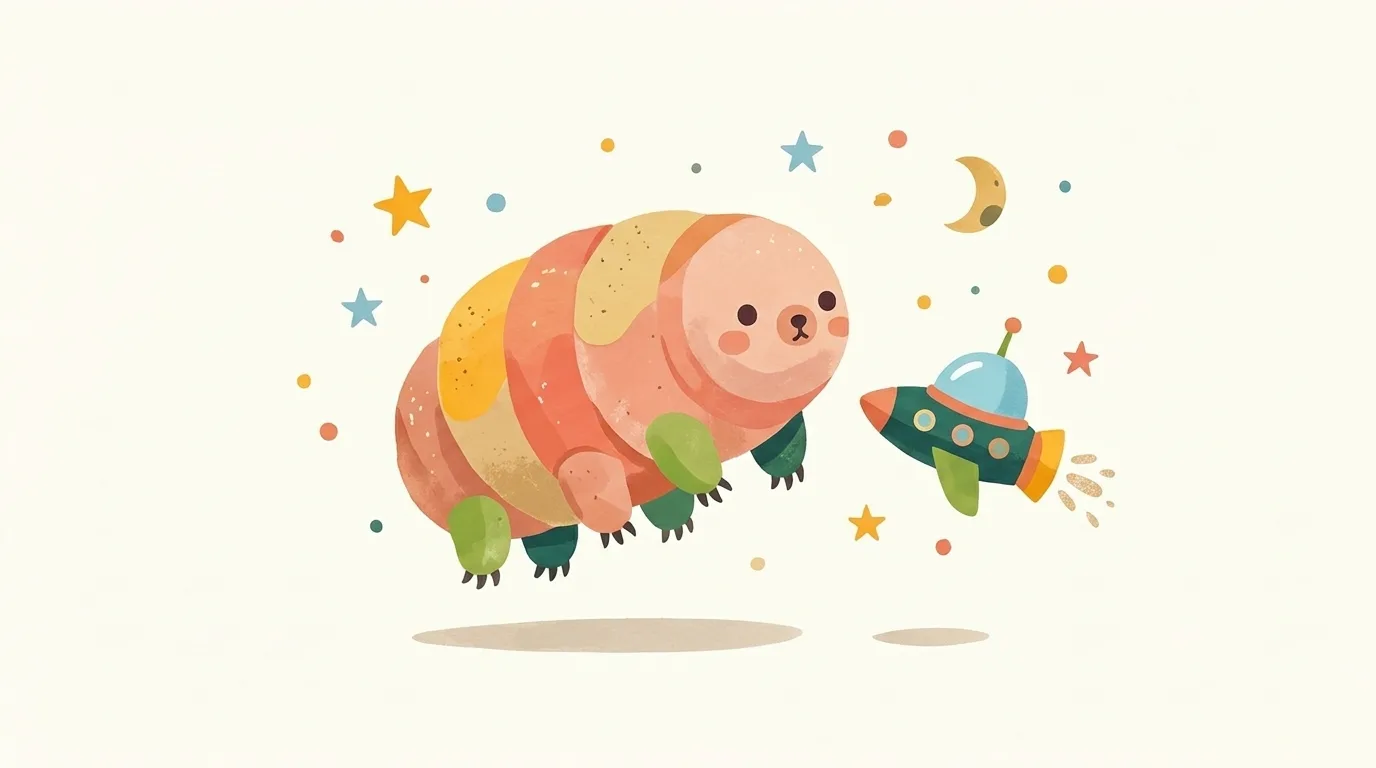
Illustration, made with AI
What tiny animal can survive in outer space?
The tardigrade, or water bear! In 2007, about 3,000 dried-up water bears rode into space for 12 days.
Out there is a vacuum, with no air at all, and fierce sunlight. The vacuum didn't hurt them, but the sunlight did.
Tough, but not unbeatable!
Tell me more
Space is hard on living things. With no air, a body dries out fast. Space is also full of radiation, and of strong ultraviolet light from the Sun. On that trip, water bears that faced only the vacuum woke up fine back on Earth. Of the ones that also faced full sunlight, only a few lived. In 2011, water bears flew to the International Space Station and coped with microgravity and with radiation. In 2019, a capsule of dried water bears rode on a spacecraft that crashed on the Moon. How a dried water bear wakes up again is a story of its own.
Words to know
- vacuuma space with almost nothing in it, not even air
- radiationinvisible energy from space that can harm living things
- microgravitywhen things fall together, so they seem to float
Try it at home
Ask a grown-up to help you look at wet moss with a magnifying glass. Tardigrades live in moss, though they are too tiny to see without a microscope.
 Dig deeper
 What else?

 Surprise me!