
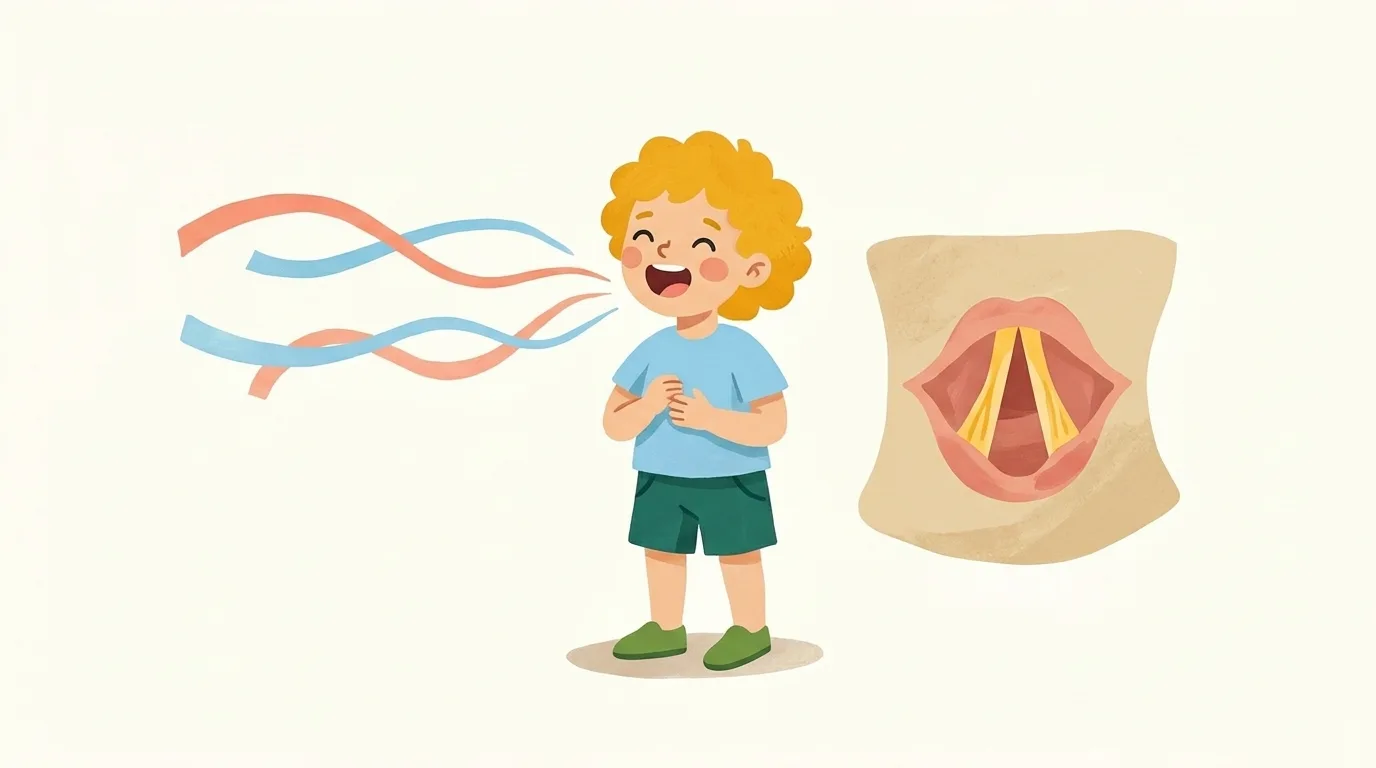
Illustration, made with AI
How does my throat make my voice go high and low?
Your voice comes from your vocal cords, two stretchy flaps in your throat.
Air from your lungs makes them vibrate. Tighter cords shake faster, so your voice goes higher. Looser cords go lower.
It's like plucking a tight or a floppy rubber band!
Tell me more
When you breathe, your vocal cords stay open so air can pass. When you talk, they snap together and the air from your lungs blows past, making them shake. They sit inside your voice box, the larynx. Each shake chops the air into little puffs, and those puffs become sound waves. Your throat, mouth and nose then shape the sound into your own voice. How high or low it sounds is called its pitch. Longer, thicker vocal cords make lower sounds. That's why most grown-ups have deeper voices than kids, whose vocal cords are much shorter.
Words to know
- vocal cordsstretchy flaps in the throat that shake to make sounds
- vibrateshake back and forth very fast
- larynxyour voice box, in your throat, that makes sounds
Try it at home
Rest your fingers gently on the front of your throat and hum a low note, then a high one. Feel the buzz? That's your vocal cords shaking!
 Dig deeper
 What else?


 Surprise me!