
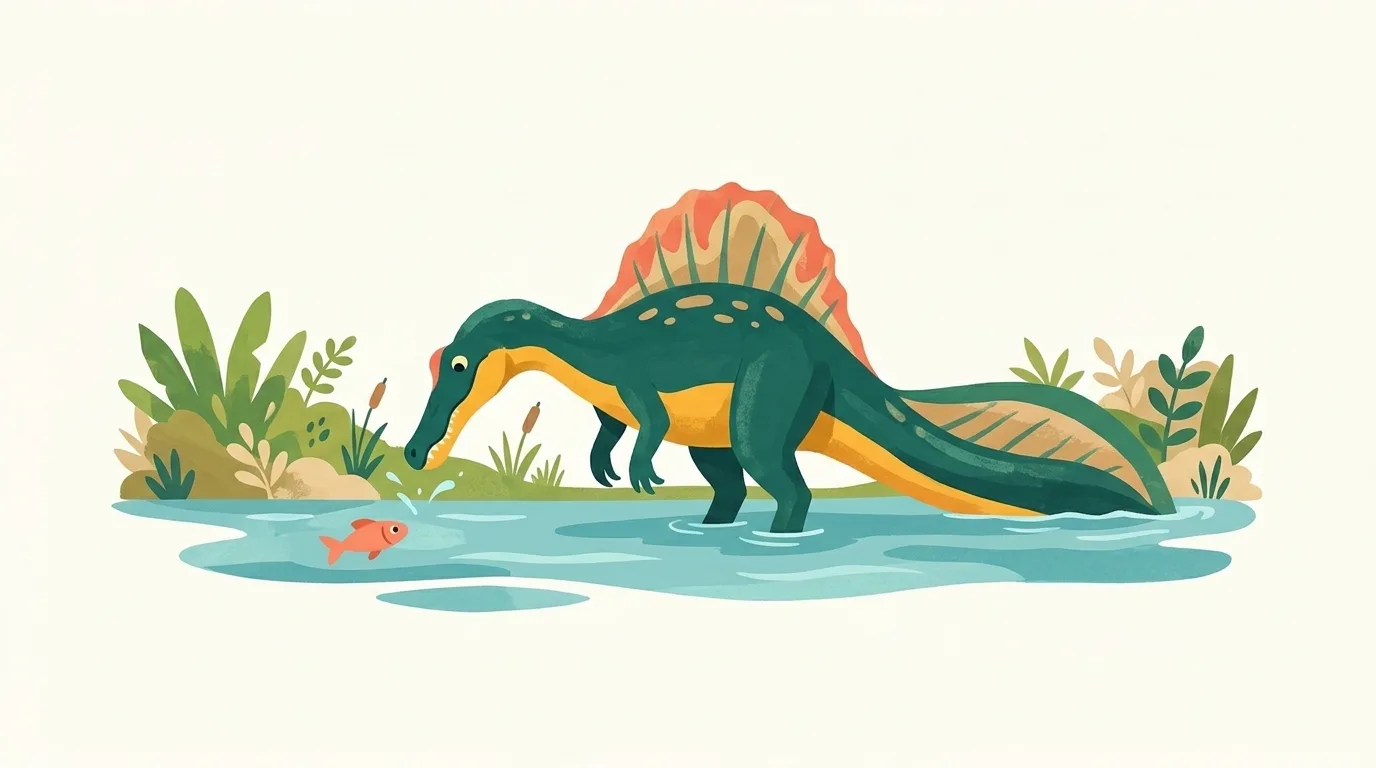
Illustration, made with AI
Could Spinosaurus swim like a crocodile?
Scientists are still arguing! Its tail was shaped like a paddle, but many think it mostly waded like a heron.
A tall, flat tail swinging side to side pushes water backwards, and that pushes the body forwards.
That's why oar blades are wide and flat.
Tell me more
Spinosaurus, the "spine lizard", lived in North Africa about 100 to 94 million years ago, among tidal flats and mangrove forests full of fish, turtles and crocodile cousins. Tail fossils found in 2018 showed a tall, flat tail like a newt's or a crocodile's. Its bones were dense and heavy, which may have helped it dive. Its feet were like a shorebird's, maybe even webbed, for walking on soft mud. But another team built a computer model and said it would be a wobbly, slow swimmer in deep water, so they think it stood in shallow water to catch fish.
Words to know
- densepacked tightly, so it is heavy for its size
Try it at home with a grown-up
In the bath, swish a flat spatula side to side, then a thin spoon handle. Feel which pushes more water. That's why a flat tail helps swimming!
 Dig deeper
 What else?
 Surprise me!