
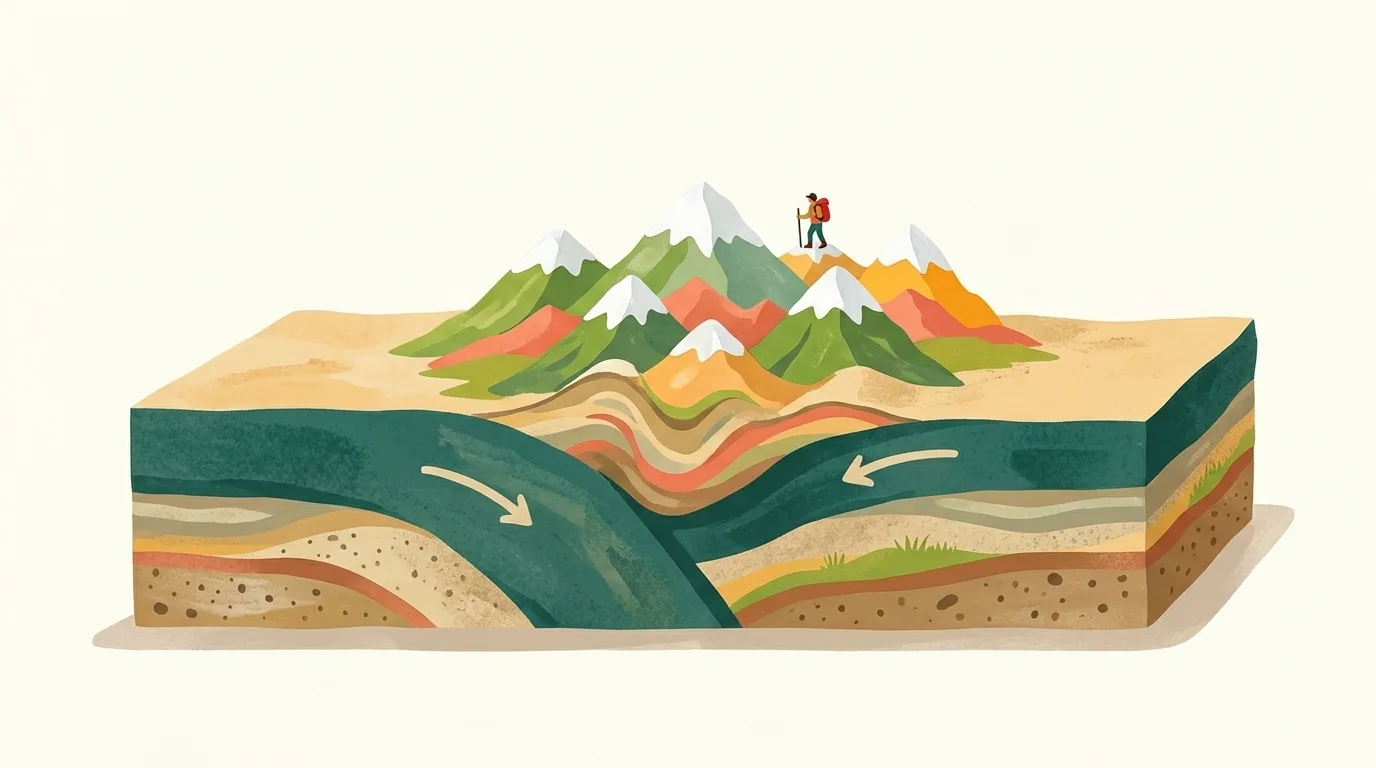
Illustration, made with AI
How do mountains grow so tall?
Giant pieces of Earth's crust slowly crash, and the rock gets pushed up!
When two plates made of equally heavy rock collide, neither can slide under the other. So their edges crumple and rise.
Push a rug against a wall and watch it wrinkle up!
Tell me more
The Himalayas, home of Mount Everest, began forming 40 to 50 million years ago, when India rammed into Asia. Long before that, India was a big island near Australia. It travelled north more than 6,000 kilometres, moving about 9 metres every hundred years. When it hit Asia, the squeezed rock had nowhere to go but up, making jagged peaks. Everest is now about 8,849 metres tall, the highest peak in the Himalayas. Rocks north of the mountains hold fossils of plants and animals from long ago, when a sea called the Tethys Sea flooded the land there.
Words to know
- crusta hard outside layer, like the rocky outside of Earth
- platesgiant pieces of Earth's crust that slowly move
- fossilsremains or traces of long-ago living things, turned to stone
Try it at home
Lay a towel flat on a table. Slowly push both ends toward the middle. Watch the wrinkles rise up: those are your mountains!

 Dig deeper
 What else?

 Surprise me!