
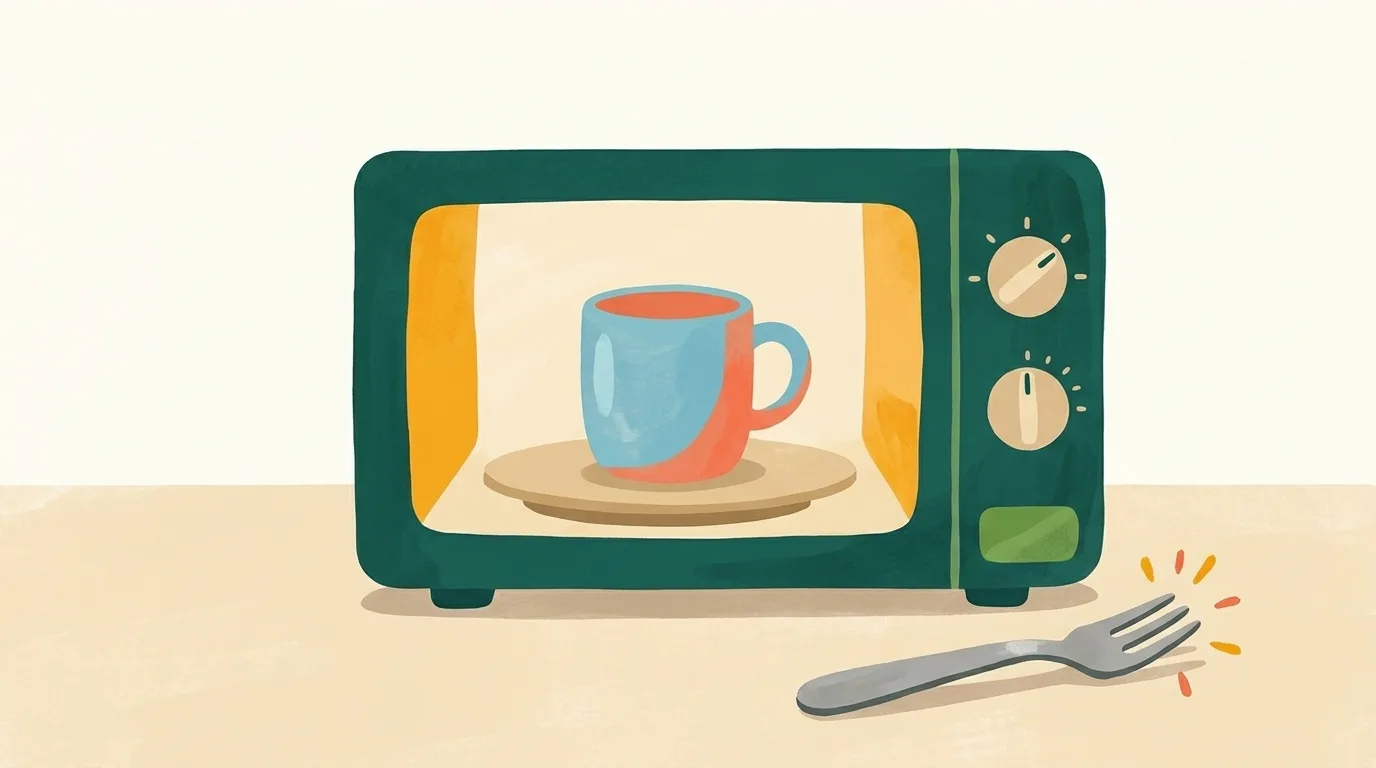
Illustration, made with AI
Why can some cups go in the microwave but not others?
It depends what the cup is made of!
Microwaves shake water to heat food. In metal, tiny bits called electrons move freely, so microwaves push them around. Pointy metal can even spark.
Glass, ceramic and many plastics lack free electrons, so they usually stay calm.
Tell me more
Microwaves are a kind of invisible energy wave, like sunlight and radio waves. They make the water in food jiggle super fast, and that jiggling heats the food. Some plastic containers are too thin: they can melt or let bits of plastic get into the food. So it's best to use only containers known to be microwave-safe. The microwave door has a metal screen with tiny holes, about 1 millimeter wide. Light waves are small enough to slip through, so you can see inside. Microwaves are about 12 centimeters from one wave peak to the next, far too big for the holes, so they bounce back in.
Words to know
- microwavesinvisible waves of energy, a bit like light
- electronssuper tiny bits inside every atom that carry electricity

 Dig deeper

 What else?


 Surprise me!