
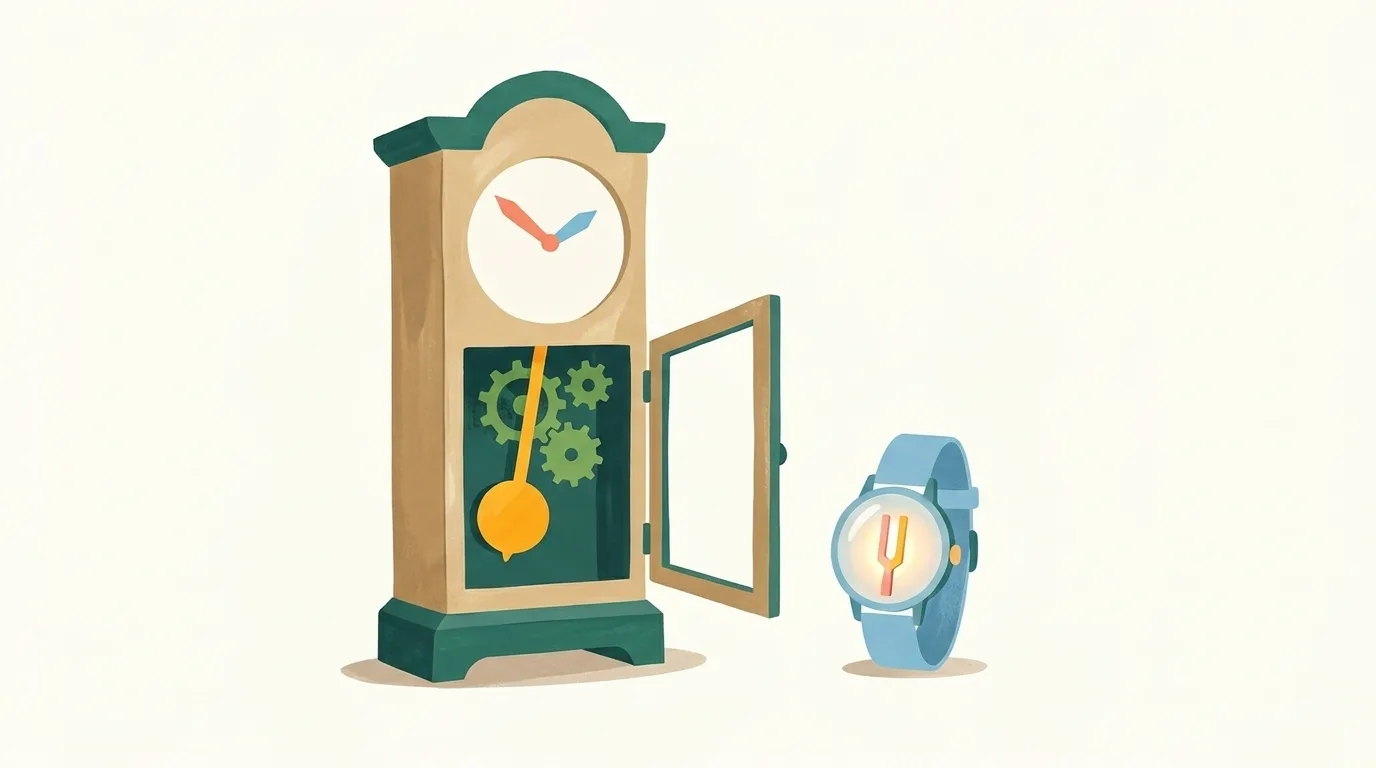
Illustration, made with AI
How do clocks work?
Almost every clock has something inside that swings or shakes at a perfectly steady beat!
The clock counts the beats. In old clocks, a pendulum swings, and gears nudge the hands forward with each swing.
It's like counting your steps to measure a walk.
Tell me more
Most clocks and watches today use a tiny piece of quartz shaped like a tuning fork. Electricity from a battery makes it vibrate 32,768 times every second! A little circuit counts those shakes, and each time it reaches 32,768, the second hand ticks forward once. The pendulum clock was invented by Christiaan Huygens in 1656. Before pendulums, clocks could be wrong by about 15 minutes every day. A pendulum's swing time depends on its length, so clockmakers set the length carefully. The most accurate clocks of all, atomic clocks, can stay within a few seconds over trillions of years.
Words to know
- penduluma weight hanging from one point that swings back and forth
- gearsa wheel with teeth that turns other wheels
- quartza tough, common mineral, often a clear or white crystal
Try it at home
Tie a spoon to a piece of string and let it swing. Now hold the string shorter. Does it swing faster or slower?

 Dig deeper

 What else?



 Surprise me!