
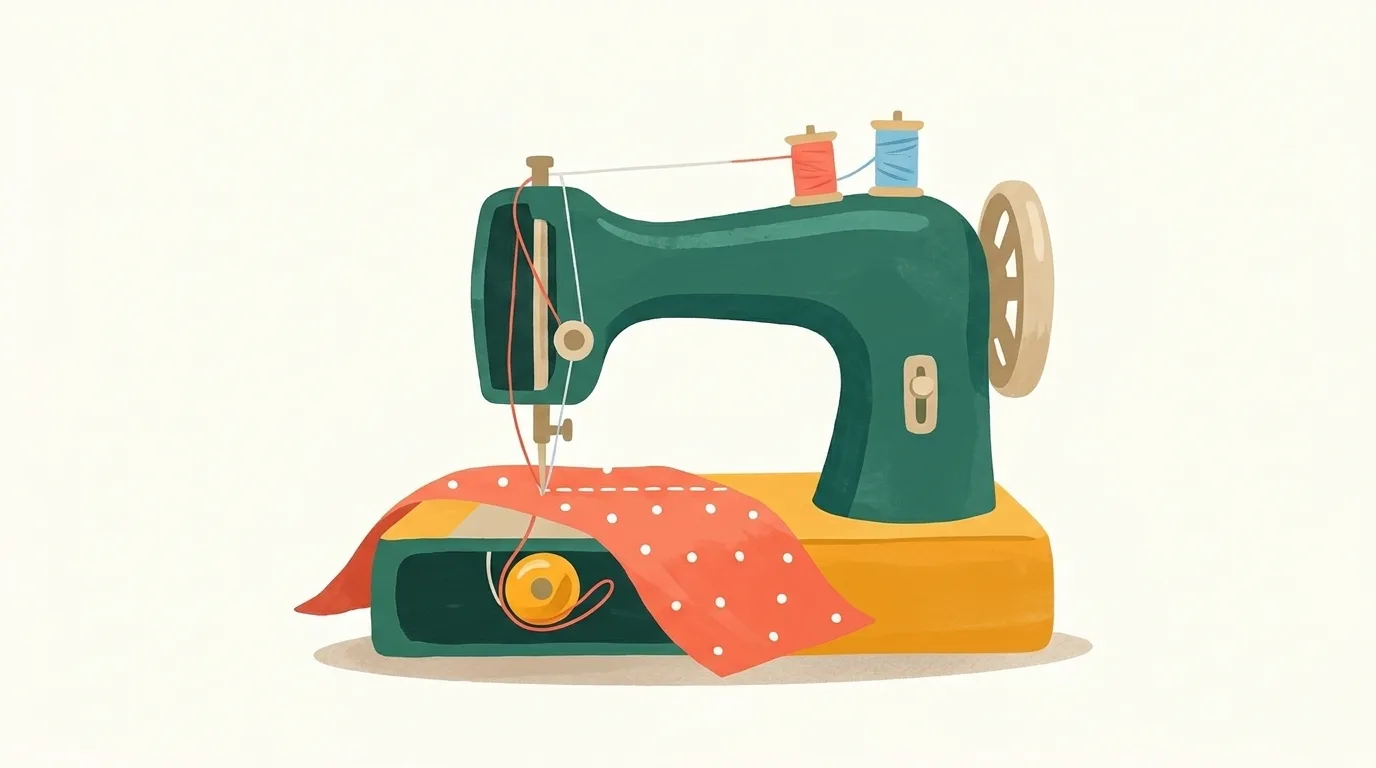
Illustration, made with AI
How does a sewing machine sew so fast?
A needle pushes thread down through the cloth, and a second thread from a little spool, the bobbin, locks it underneath!
The two threads twist around each other at every needle hole. That lock is why the stitch is called a lockstitch.
Tell me more
Each thread stays on its own side of the cloth. They meet and interlace inside every needle hole. The cloth also has to move so that each stitch lands in a new place. That movement is called the feed. Early inventors tried many ways. A German-born engineer in England got a patent in 1755 for a double-pointed needle with the eye at one end. Thomas Saint designed an early sewing machine in 1790. Elias Howe made his in 1845. The first electric machines came from Singer in 1889. Over three dozen different kinds of stitch are recognized by an international standard.
Words to know
- bobbina small spool that holds thread
Try it at home
Look closely at a seam on a shirt. What do the stitches look like on the front and on the back?
 Dig deeper
 What else?
 Surprise me!