
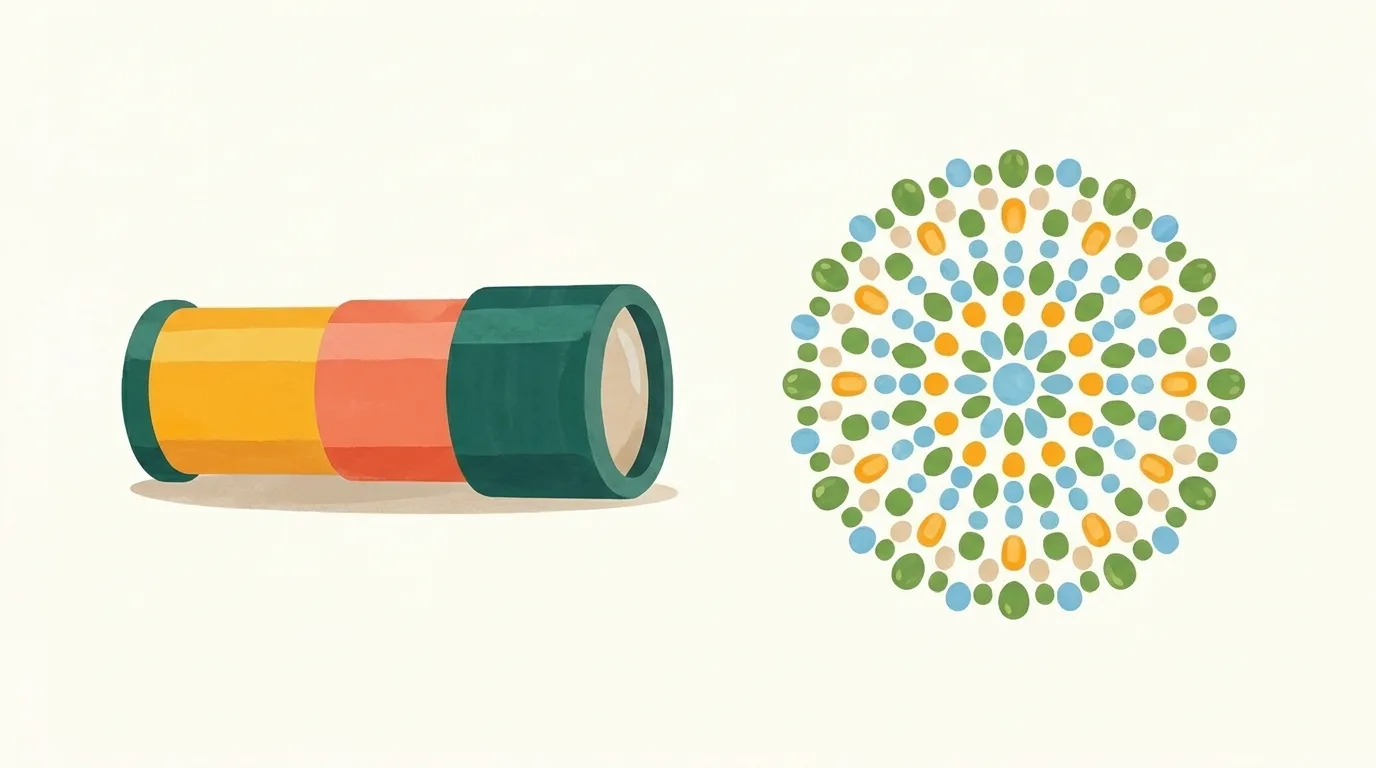
Illustration, made with AI
How does a kaleidoscope make so many patterns?
A few mirrors turn a handful of beads into a pattern.
A kaleidoscope has two or more mirrors tilted toward each other. Their reflections repeat the loose colored pieces into a neat symmetrical pattern. Turn it, and the pieces move, so the pattern changes.
Tell me more
The word kaleidoscope comes from Greek words meaning beautiful, form and to look. A Scottish scientist, Sir David Brewster, invented it. In 1814, he noticed a circle of images of a candle bouncing between glass plates. The patent was granted on July 10, 1817. Many things can go inside, such as colored glass, small figures and liquids. The Italian writer Giambattista della Porta had described repeated reflection between mirrors long before, in the 1500s. The mirrors can be mirror glass, plain glass or metal, and the choice changes the tint of the picture.
Words to know
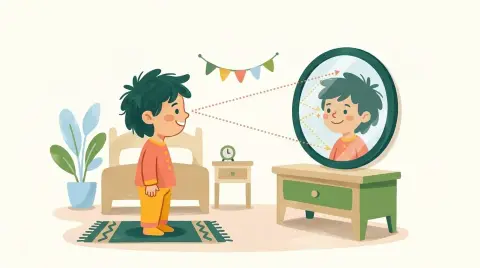
- reflectionlight bouncing off something
Try it at home
If you have a toy kaleidoscope, point it at a window and turn it slowly. Count how many times one colored bead repeats.
 Dig deeper

 What else?



 Surprise me!