
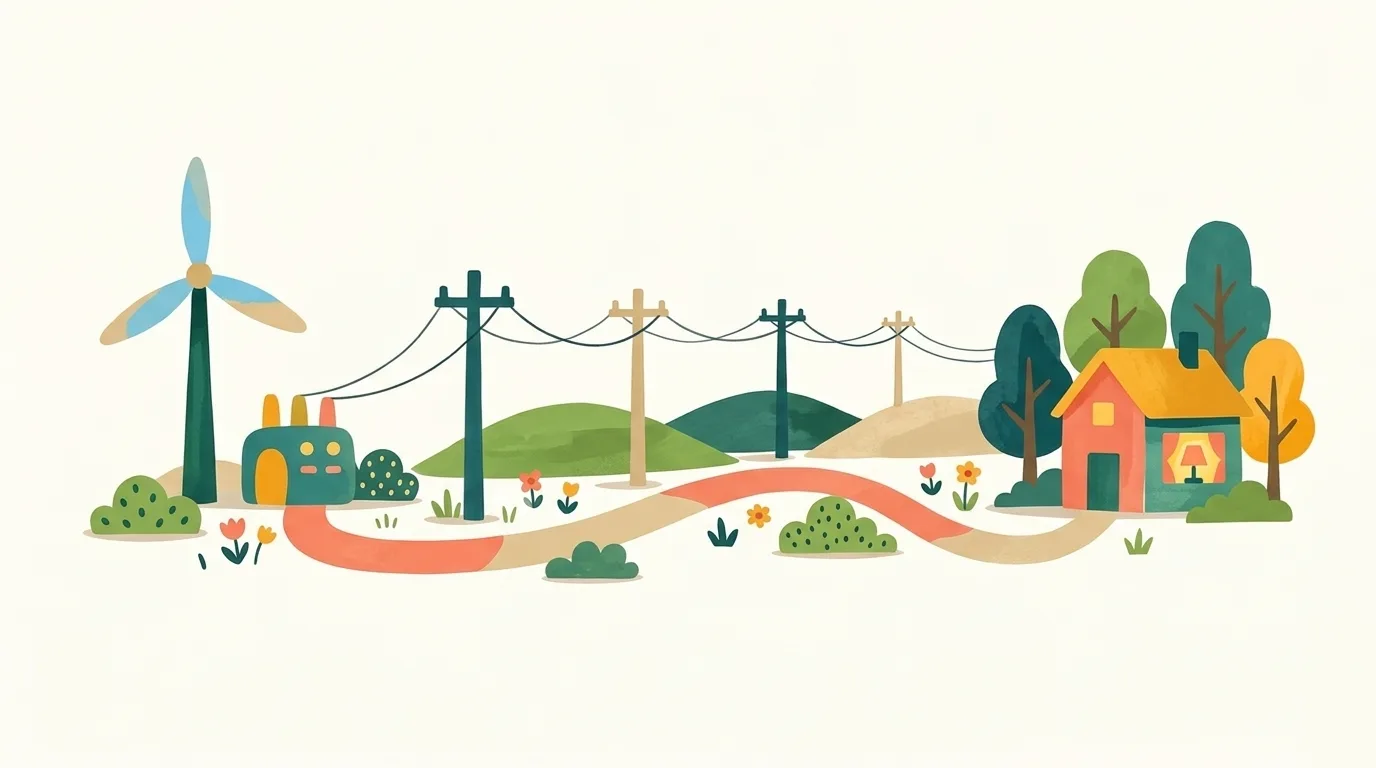
Illustration, made with AI
What is electricity, and how does it reach our lights?
Electricity is tiny bits called electrons moving along wires.
At a power station, a spinning machine pushes the electrons. Wires carry that push all the way to your bulb.
It's like a hose full of water: turn the tap, and water comes out at once.
Tell me more
Inside a power station's generator, magnets spin past coils of copper wire, and that pushes electrons along. Almost every power station works by spinning, with steam, wind or falling water doing the turning. Solar panels and fuel cells are the only big ways of making electricity without a generator. A machine called a transformer lets the power travel a long way along tall power lines at a high push, called voltage, without wasting much. The first power station to light a city street opened in 1882, on Pearl Street in New York. A steam engine turned its generator.
Words to know
- electronssuper tiny bits inside every atom that carry electricity
- generatora machine that turns spinning into electricity
- voltagehow hard electricity is being pushed
Try it at home
On a walk, spot the power lines or poles. Follow them with your eyes: they're carrying electricity to homes like yours.
 Dig deeper
 What else?
 Surprise me!