
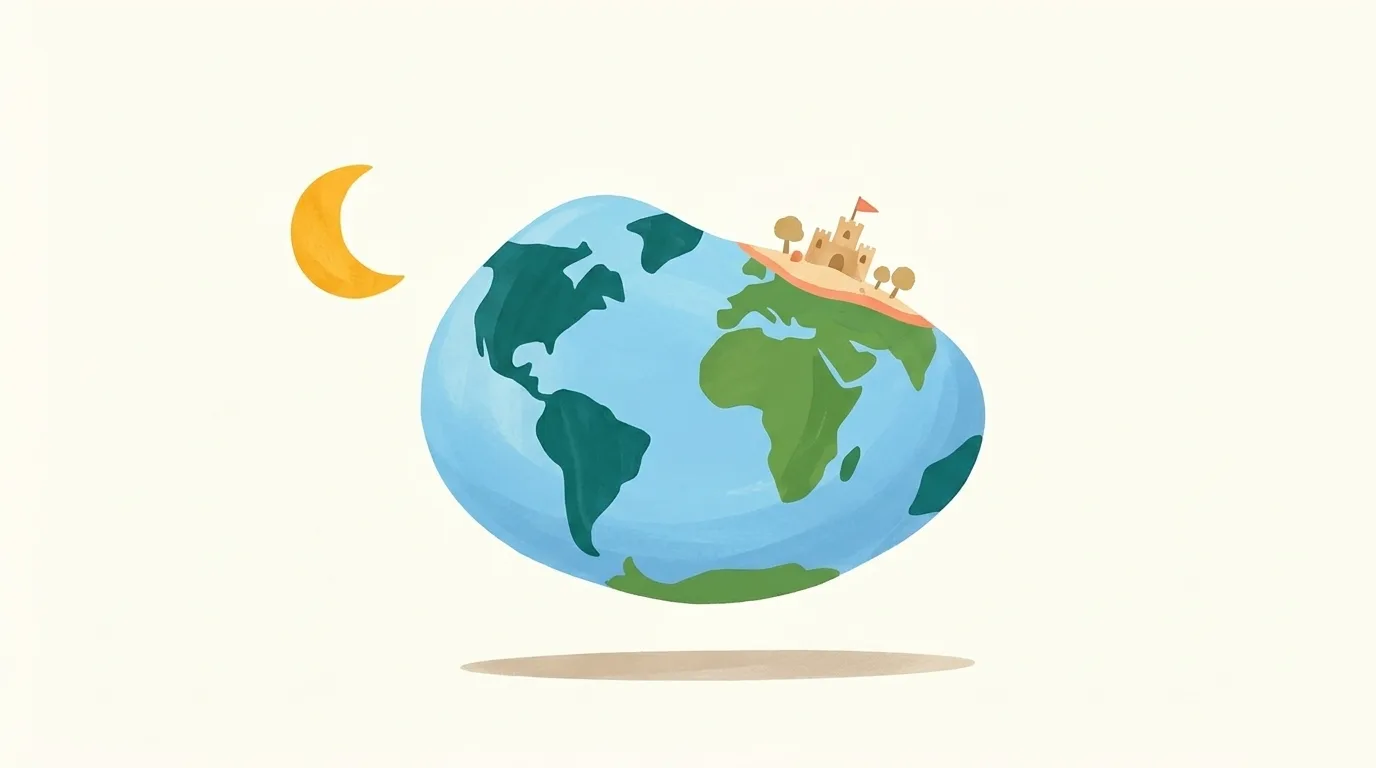
Illustration, made with AI
Why are there two high tides every day?
Because the sea bulges out on the far side of Earth too, away from the Moon!
The Moon's pull is weakest there. That water tends to keep going in a straight line, away from Earth, so it heaps up.
Two bulges, two high tides.
Tell me more
It sounds strange, but the Moon's gravity pulls on every bit of Earth at once: the water facing it, the rocky middle, and the water on the far side. The pull is strongest nearest the Moon and weakest farthest away. Water's habit of keeping on going is called inertia. Near the Moon, gravity wins and pulls the water into a bulge. On the far side, inertia wins and makes the second bulge. Earth spins through both. The bulges are never exactly under the Moon, either: Earth's fast spin carries them a little ahead of it. So you can't predict the tide just by watching the Moon.
Words to know
- tidesthe sea slowly rising and falling at the shore
- inertiamoving things keep moving until something stops them
- gravitythe invisible pull that draws things toward each other

 Dig deeper
 What else?


 Surprise me!