
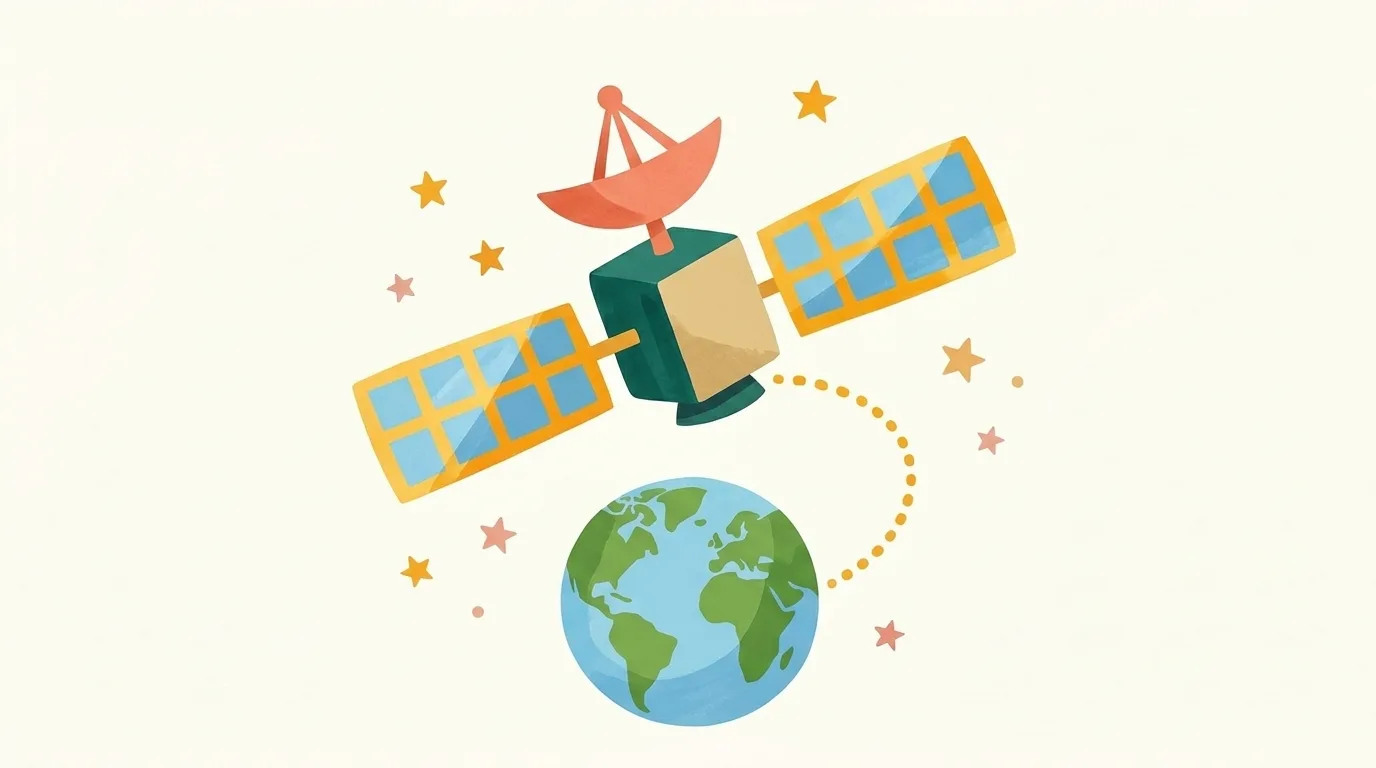
Illustration, made with AI
How do satellites stay up there, and what do they do for us?
Satellites stay up because their speed and Earth's gravity are balanced.
Gravity pulls them toward Earth, while their speed carries them forward. Together, that bends their path into an orbit around Earth.
They watch the weather, carry phone calls and help maps find your way!
Tell me more
A satellite is anything that orbits a planet or a star, so the Moon is a satellite too! But thousands of satellites circling Earth are machines that people made. Most ride to space on rockets. Most have an antenna to send and receive messages, and a power source such as batteries or solar panels. A group of more than 30 satellites works together as GPS, which helps a phone figure out exactly where you are. Some satellites fly so high above the clouds that they can see space more clearly than telescopes on the ground. Others look down and help forecasters predict the weather.
Words to know
- satellitesmachines that circle around Earth high up in space
- orbitthe curved path one thing takes going around and around another
- solar panelsflat panels that turn sunlight into electricity
Try it at home
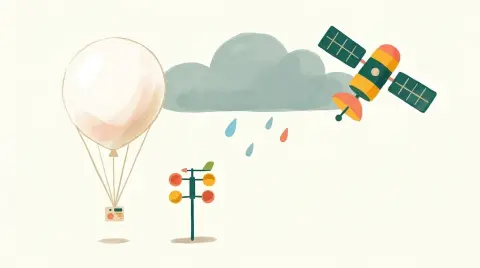
Look at today's weather forecast with a grown-up. A satellite high above the clouds helped make it!

 Dig deeper
 What else?

 Surprise me!