
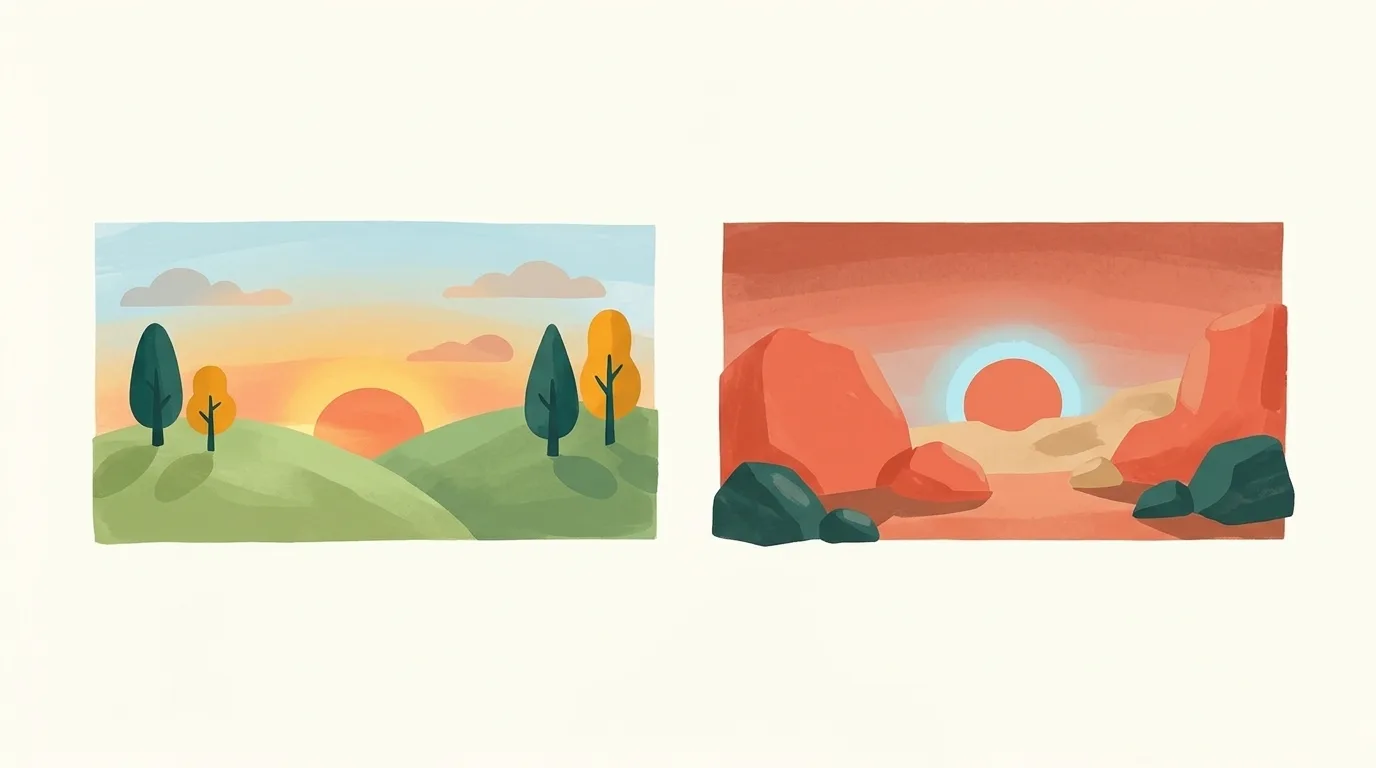
Illustration, made with AI
Is the sky blue on other planets?
Not usually! On Mars, the daytime sky is reddish, but sunsets glow blue.
A sky's color depends on what floats in its air. Earth's air scatters blue light. Mars's dust soaks up most blue light, but scatters some near the Sun.
Like Earth's colors swapped!
Tell me more
Some planets do have blue skies, but a different blue from ours. Uranus and Neptune look blue because their air holds lots of a gas called methane. Uranus also has some ammonia, which makes it a little greener than Neptune. High clouds of ammonia ice make Saturn pale yellow. Jupiter has brown and orange stripes, perhaps from gases with sulfur and phosphorus in them. Mercury, closest to the Sun, has almost no air at all. On Mars, the blue near the setting Sun comes from the dust itself. It only shows at sunrise and sunset, when sunlight passes through the most dust.
Words to know
- scatterlight bouncing off tiny bits in every direction
- methanea gas with no color, made of carbon and hydrogen

 Dig deeper
 What else?

 Surprise me!