
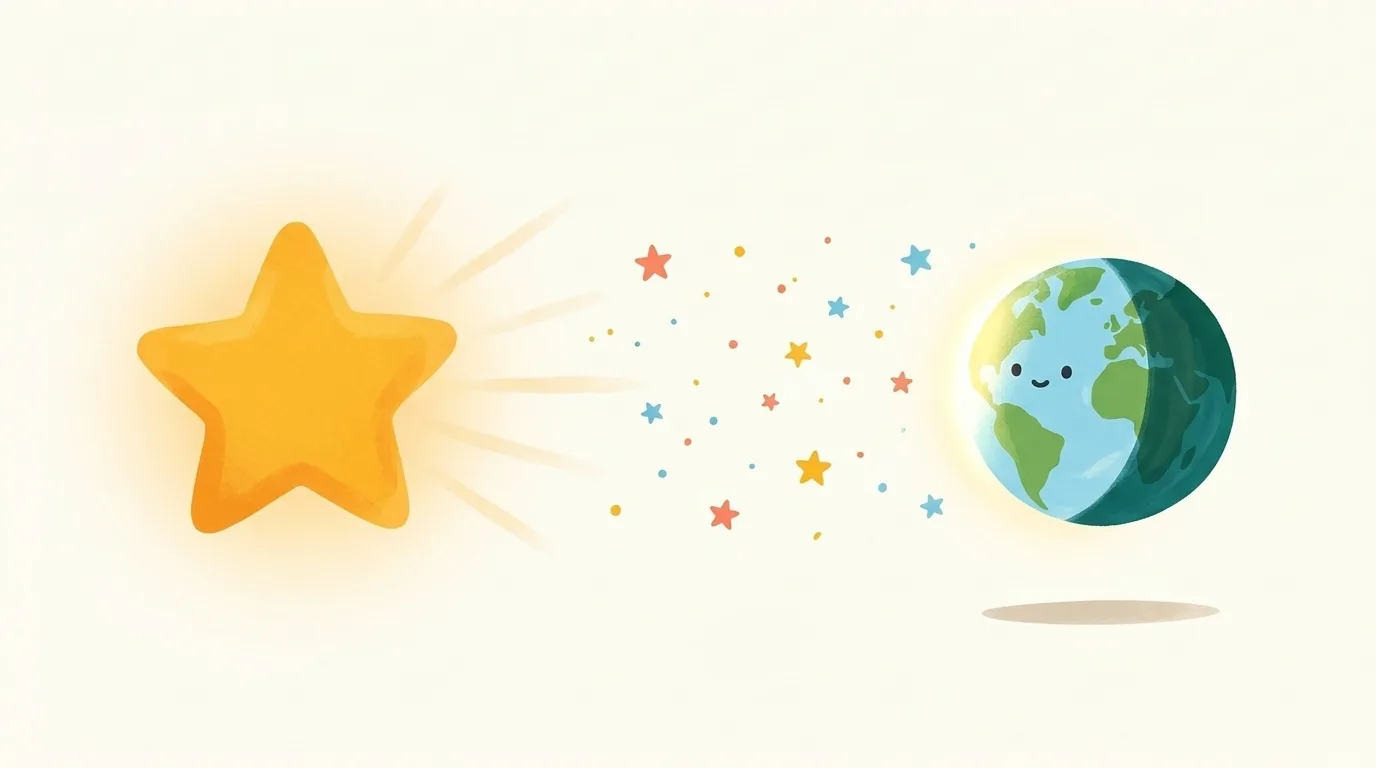
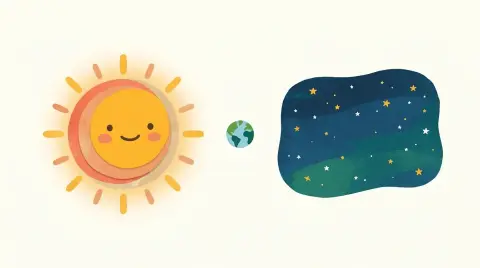
Illustration, made with AI
What's the difference between a planet and a star?
A star makes its own light! A planet doesn't.
Deep inside a star, nuclear fusion squeezes hydrogen into helium, and that gives off light. A planet only shines when starlight bounces off it.
A star is like a lamp. A planet is like a mirror.
Tell me more
Stars are giant balls of hot gas, mostly hydrogen with some helium. Our Sun is a star. To count as a planet, a world must do three things: travel around a star, be big enough for its gravity to pull it into a ball, and clear other big things out of its path. Some gas clouds collect into balls that are too small to become a bright star. These are called brown dwarfs, and they don't give off much light. In our night sky, planets can look about the same size as stars, because planets are so much closer to us.
Words to know
- nuclear fusiontiny bits squeezing together and joining, giving off light and heat
- hydrogenthe lightest gas, the main fuel inside stars
- brown dwarfsballs of gas too small to shine like a real star
Try it at home
On a clear night, look for bright dots in the sky. Stars twinkle a lot. A bright dot that shines steadily, without much twinkling, might be a planet!
 Dig deeper
 What else?

 Surprise me!