
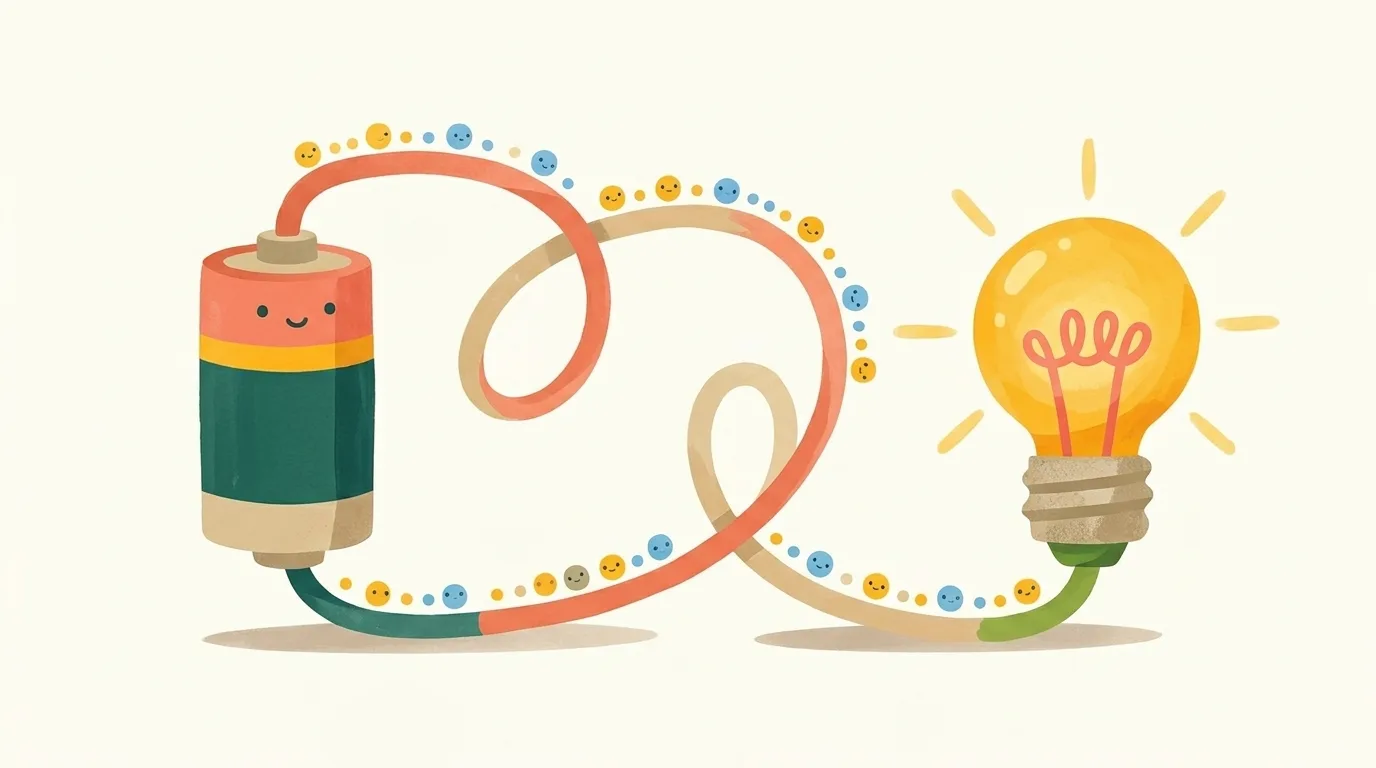
Illustration, made with AI
What is electricity and how does it zip through wires?
It's tiny electrons on the move, carrying energy around a loop!
A battery pushes the electrons along. Metals like copper have free electrons that can flow, so electricity zips through a copper wire.
The electrons carry energy like marching ants carrying leaves!
Tell me more
The loop is called a circuit. If there is a break anywhere in it, the electricity stops and the lamp goes dark. A switch works by opening a gap in the loop. Rubber and plastic hold their electrons tightly, so electricity can't flow through them. They are called insulators, and that's why wires wear plastic coats. In a torch, electrons flow one way round the circuit: that's direct current. In the sockets at home, they swap direction many times every second: that's alternating current. A bolt of lightning is electricity too, leaping between a cloud and the ground.
Words to know
- electronssuper tiny bits inside every atom that carry electricity
- circuita complete loop that electricity travels around
- insulatorssomething electricity can't flow through easily
Try it at home
Rub a balloon on your hair, then hold it near tiny bits of paper. Watch them jump up. That's static electricity!
 Dig deeper
 What else?


 Surprise me!