
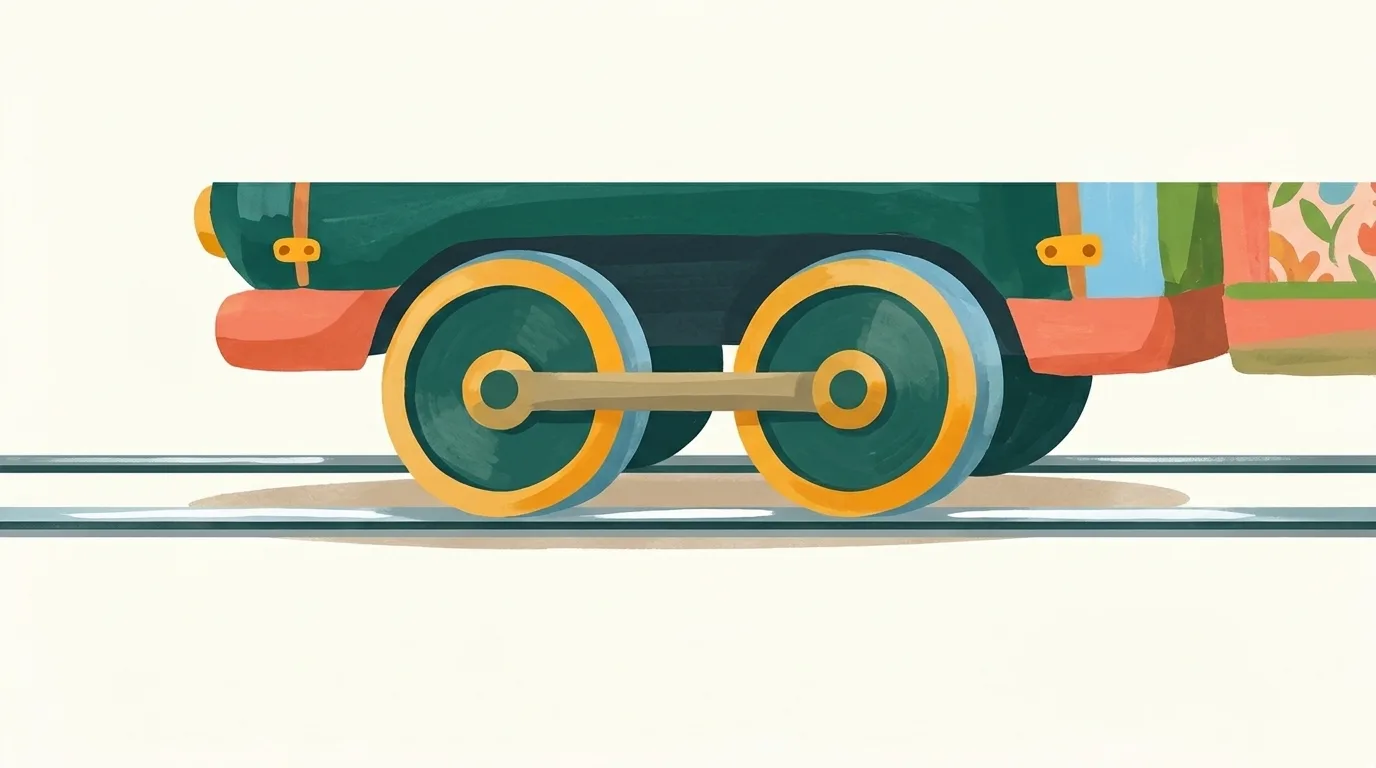
Illustration, made with AI
How do trains stay on their tracks?
Their wheels are shaped like cones, so they steer themselves!
If a train drifts sideways, one wheel rides on its wider part, the other on its narrower part. That rolls them back to the middle.
Roll a paper cup: it curves around all by itself!
Tell me more
Two wheels are fixed to one straight axle, so they always spin together. Engineers call this a wheelset. On a curve, the outer wheel rides on its wider part, so it travels farther with each turn than the inner wheel. That steers the whole wheelset around the bend. No steering wheel needed! A lip on the inside edge of each wheel, called a flange, is a backup. It only matters when there is a strong sideways push, like on a very tight curve or a bumpy bit of track. Then the flange stops the wheels from slipping off the rails.
Words to know
- axlethe rod a wheel turns on, often joining two wheels
- flangethe lip on a train wheel that keeps it on the rail
Try it at home
Tape two paper cups together at their wide ends. Lay two rulers side by side as rails and roll the cups along. Watch them stay on!
 Dig deeper
 What else?

 Surprise me!