
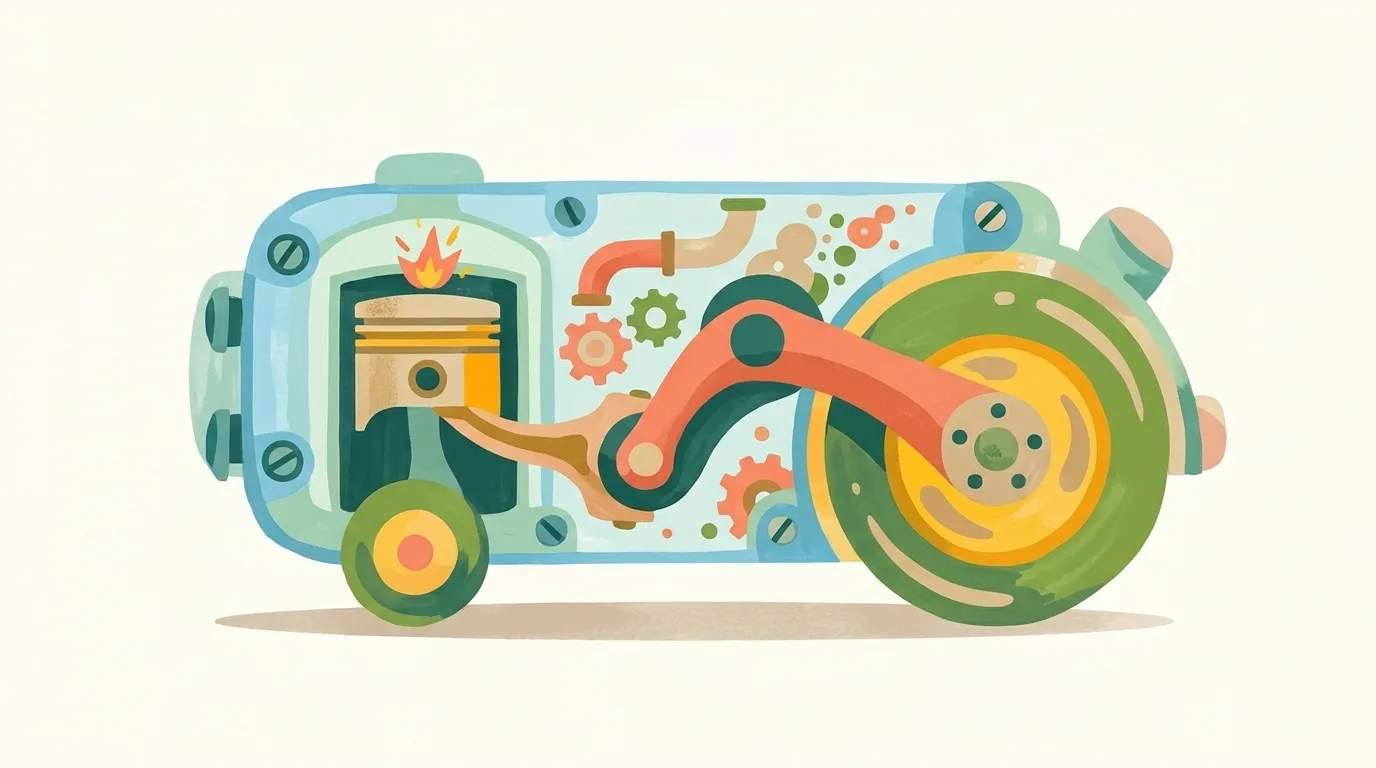
Illustration, made with AI
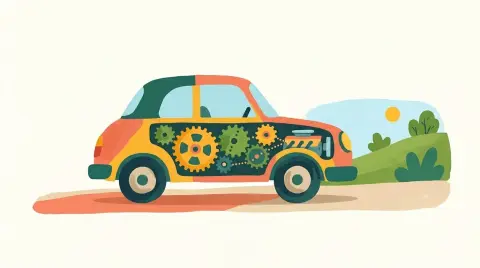
How does a car engine make the car go?
Tiny bursts of burning fuel push pistons, and the pistons turn the wheels!
A spark lights squeezed fuel and air. The burst shoves a piston down, and a bent rod, the crankshaft, turns that push into spinning.
It's like legs pushing bike pedals!
Tell me more
Each piston moves in four steps, called strokes. Intake: it slides down and pulls in fuel and air. Compression: it slides up and squeezes them tight. Power: a spark plug lights the mix, and the burst shoves the piston down. Exhaust: it slides up and pushes the used gases out. Then it all starts again. Diesel engines need no spark: squeezing the air makes it hot enough to light the fuel. A man named Nicolaus Otto built the first engine that squeezed its fuel like this, in 1876. Squeezing first made engines much better at using fuel than any engine before.
Words to know
- pistonsa part that slides back and forth inside a tube when pushed
- spark pluga part that makes a tiny spark to light the fuel
- crankshafta bent rod that turns up-and-down pushes into spinning
Try it at home
Pedal a bike, or watch someone pedal. Legs push up and down, and the pedals turn that into spinning, just like an engine's crankshaft.
 Dig deeper
 What else?
 Surprise me!