
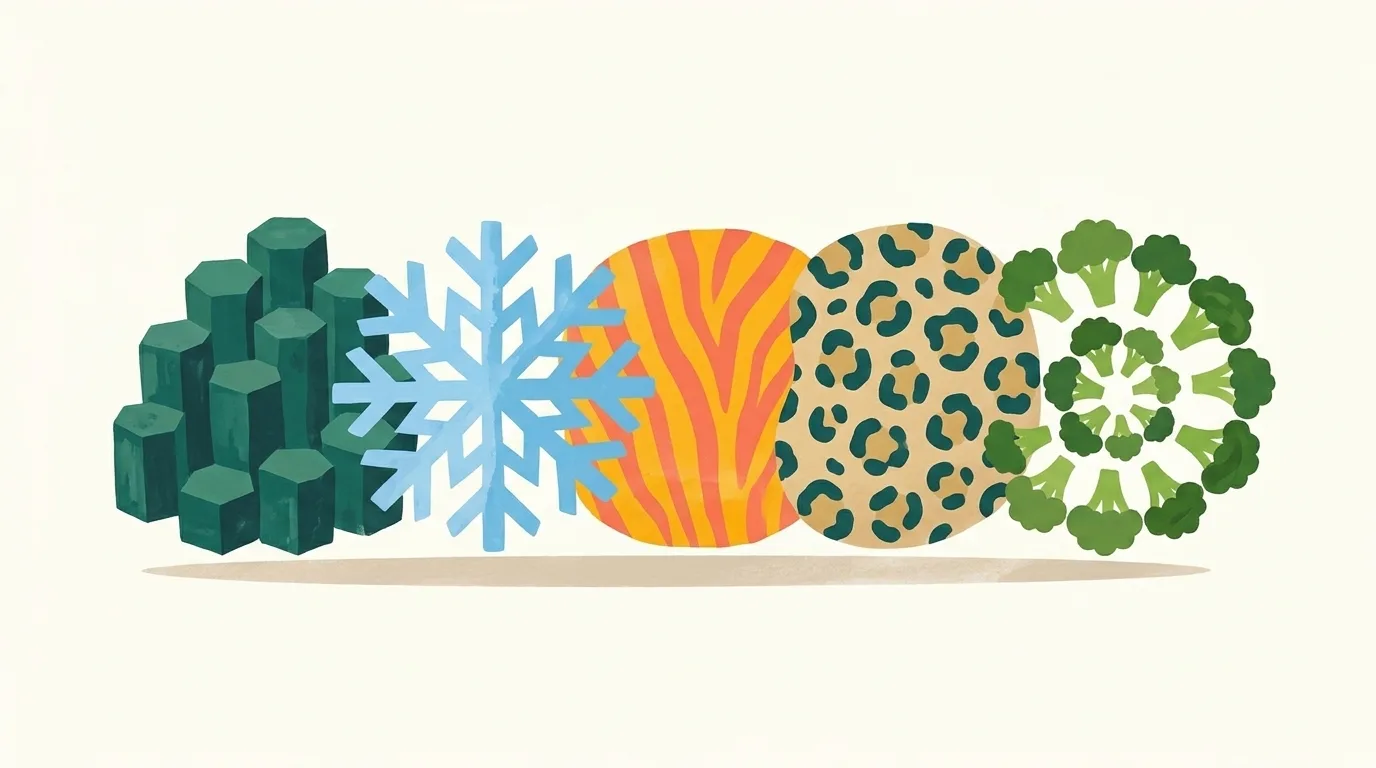
Illustration, made with AI
Why does nature make patterns?
Because simple rules repeat! Tiny bits stack, crack and spread the same way, again and again.
Freezing water molecules stack into six-sided shapes, building frost and snowflakes. Cooling lava cracks into six-sided columns too.
One small rule, repeated, makes a big pattern.
Tell me more
Living things make patterns in a similar way. When one chemical spreads through another, that's called diffusion. In 1952, a mathematician named Alan Turing showed that chemicals spreading and reacting like this can make patterns all by themselves. Scientists have shown this process can make patterns like leopard spots and zebra stripes. A tiger's stripes help it hide in tall grass while hunting. Researchers are still working out exactly which chemicals are involved. Sometimes nobody knows whether a pattern has a purpose at all. Under a microscope, pollen grains from different plants are covered in spikes and stripes, and scientists don't know why.
Words to know
- moleculesone of the tiny pieces everything is made of
- diffusiontiny bits spreading out from a crowded place
- lavamelted rock that has come out of a volcano
Try it at home with a grown-up
With a grown-up, put one drop of food coloring into a clear glass of still water. Watch it spread without stirring. That's diffusion!
 Dig deeper
 What else?
 Surprise me!