
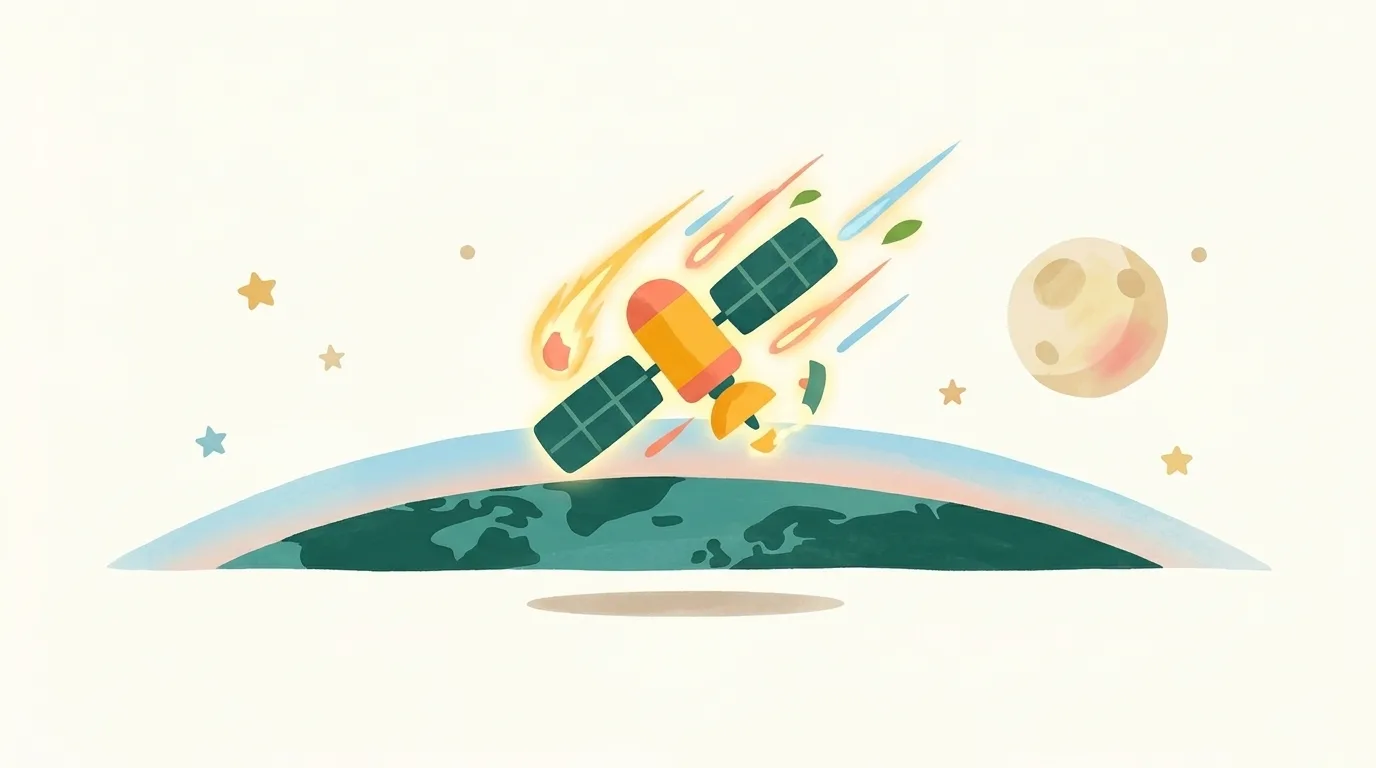
Illustration, made with AI
How do satellites get back to Earth?
Most satellites never come back in one piece! When they finally fall, they burn up high in the sky.
Thin air slowly drags a satellite lower. Then it plunges so fast that rushing air heats it until it breaks apart.
Like a human-made shooting star.
Tell me more
A satellite is always falling toward Earth, but it moves sideways so fast that it keeps missing. That is what an orbit is. When the Sun heats our air, the air puffs outward and rubs against the lowest satellites. Scientists call this rubbing friction, and it slows them down. Some satellites fall back within weeks; others stay up for hundreds of years. A falling satellite can hit the air at up to 28,000 kilometers per hour, about 35 times faster than a plane. A few satellites are built to come home, carrying samples for scientists. Heat shields and parachutes help them land gently.
Words to know
- orbitthe curved path one thing takes going around and around another
- frictionthe rubbing force that slows or stops things sliding
 Dig deeper

 What else?



 Surprise me!