
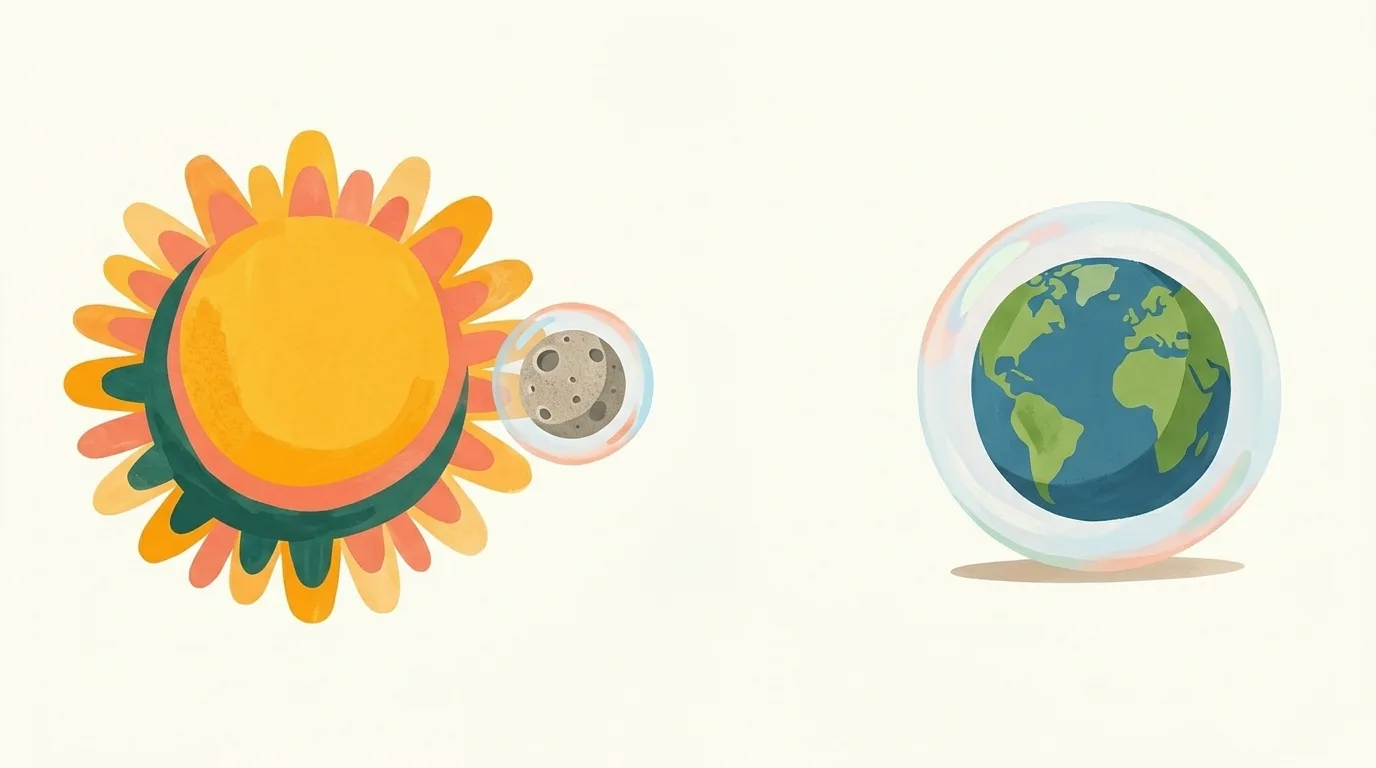
Illustration, made with AI
Why doesn't Mercury have any moons?
Probably because the Sun is so close.
Around each planet is a space where its pull beats the Sun's. Mercury is small and near the Sun, so its space is tiny. A moon couldn't easily stay.
Like a small magnet beside a giant one.
Tell me more
Scientists call that space a planet's Hill sphere. Mercury's Hill sphere is about eight times smaller across than Earth's. That makes it hard for a moon to stay in orbit, which means going around and around. Venus has no moon either, so Mercury and Venus are the only two planets without one. To be sure, NASA's MESSENGER spacecraft, which went around Mercury from 2011 to 2015, searched for moons in 2011 and 2013. It found none. Spotting a moon from Earth would be very hard, because Mercury always stays close to the bright Sun in our sky.
Words to know
- Hill spherethe space where a planet's pull beats the Sun's
- orbitthe curved path one thing takes going around and around another

 Dig deeper
 What else?



 Surprise me!