
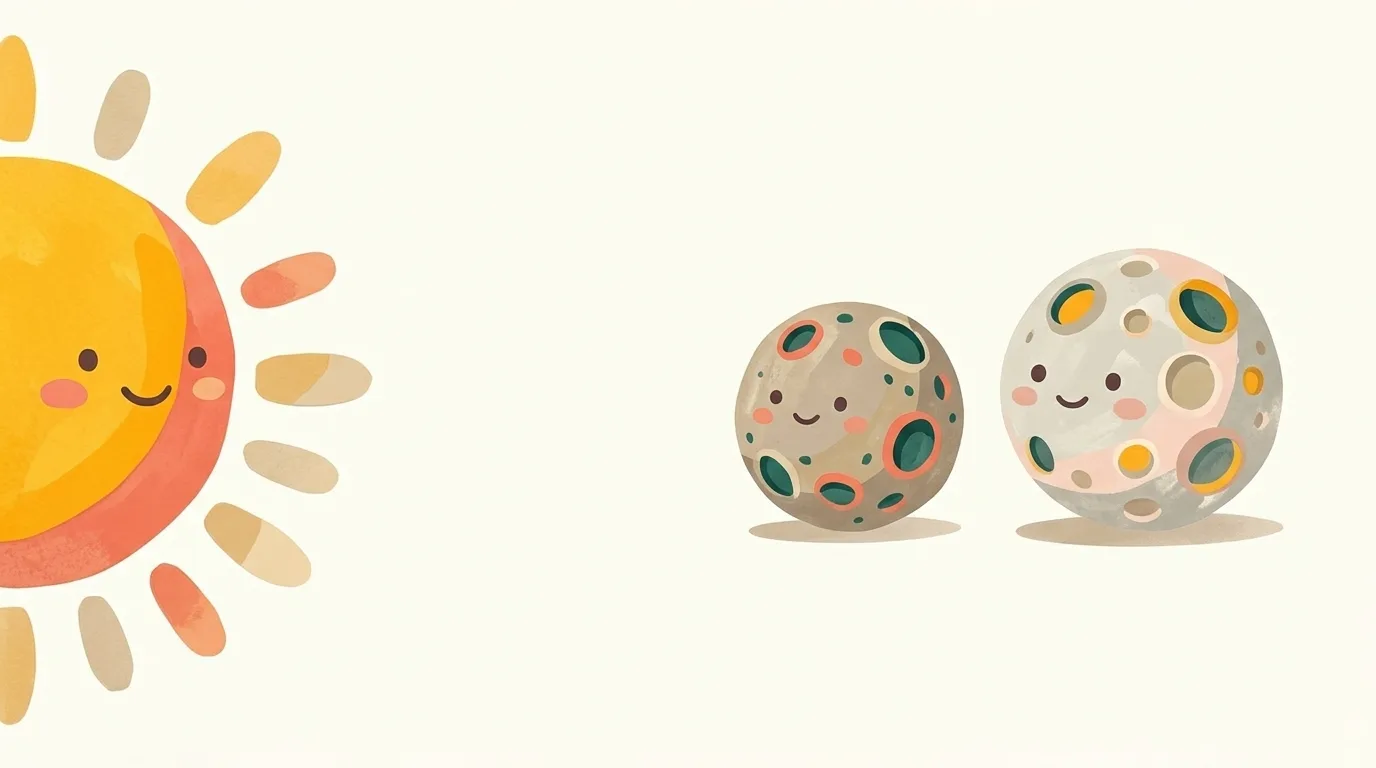
Illustration, made with AI
Why does Mercury look like our Moon?
Both are covered in craters, holes made when space rocks crashed in.
Neither has thick air to slow the rocks, so they hit hard. And nothing wears old craters away, so they last billions of years.
It's like footprints in snow that never melts.
Tell me more
On Earth, craters slowly get worn away by weather, buried, or changed as the ground moves, so we see far fewer. Mercury is the smallest planet, only a little bigger than our Moon, and it looks a lot like it in other ways too. Long ago, melted rock flooded some of its giant crater holes and made smooth plains, like the dark patches on the Moon. Mercury also has cliffs up to about a mile high. They rose as the inside of the planet cooled and shrank. One of Mercury's biggest crater basins, Caloris, is about 1,550 kilometres wide.
Words to know
- cratersa big bowl-shaped hole made when something crashes in
- plainswide, flat, smooth land
Try it at home
Fill a tray with flour and drop pebbles in from different heights. Look at the craters you make!
 Dig deeper
 What else?

 Surprise me!