
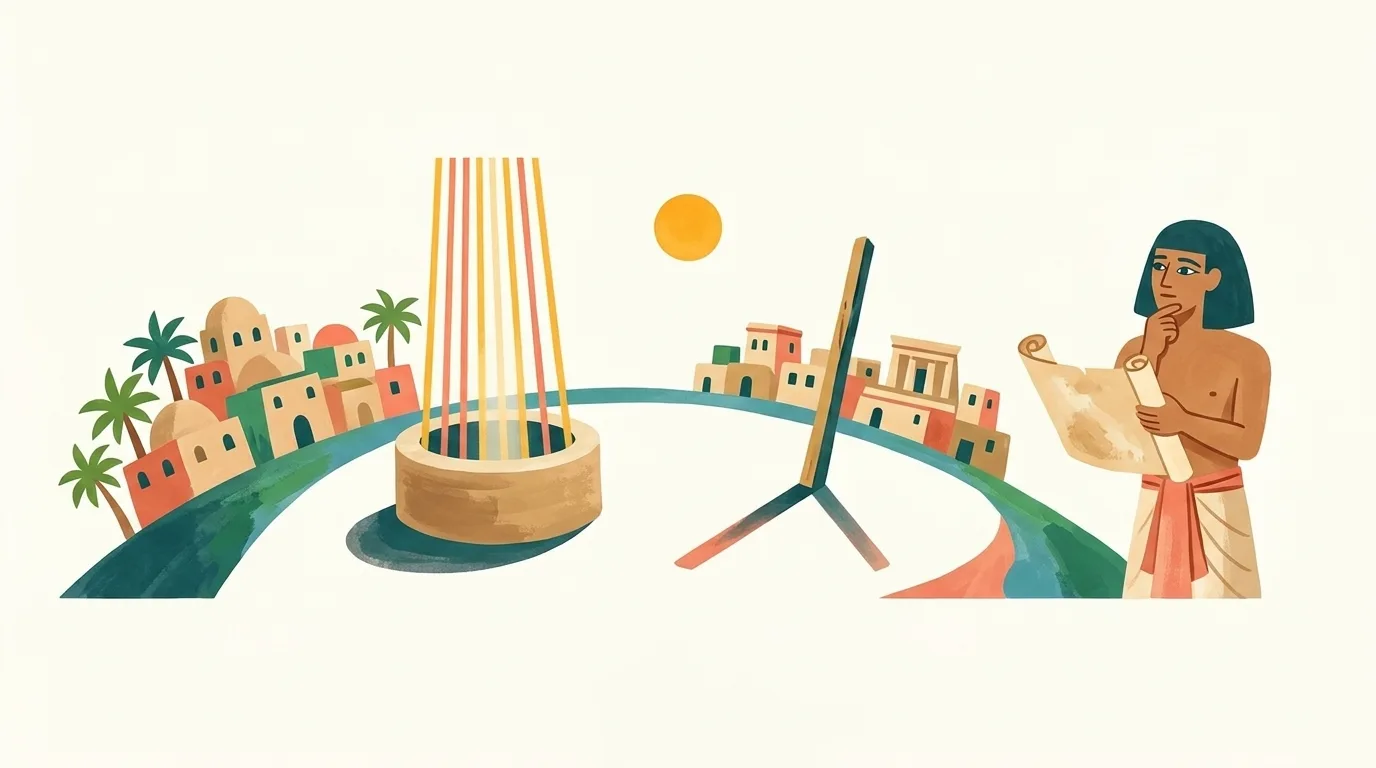
Illustration, made with AI
How did a shadow show how big the Earth is?
Its tilt showed what slice of Earth lay between two cities!
Sunbeams arrive side by side. So when one city's stick had no shadow, another city's shadow tilted by that same slice.
The two sticks are like two spokes meeting at a wheel's middle.
Tell me more
Sunbeams reach Earth almost parallel, like the rails of a train track. On a round Earth, upright sticks all point towards its middle. Picture Alexandria's stick pushed right down to Earth's middle. It crosses two parallel sunbeams: the one making its shadow, and the one shining straight down Syene's well. A line crossing two parallel lines makes the same angle with each. So the shadow's angle, about 7.2 degrees, is also the angle between the two cities at Earth's middle. That is one-fiftieth of a circle, so the circumference is 50 times the distance between them: about 250,000 stadia.
Words to know
- circumferencethe distance all the way around a circle
- anglehow much something is tipped or turned
Try it at home
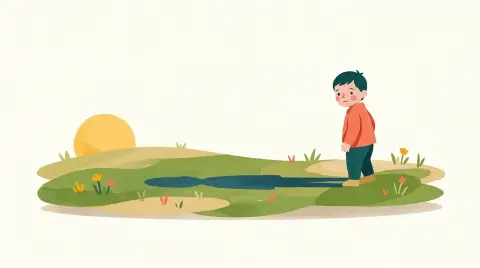
Stand a pencil upright in modelling clay outside on a sunny day. Mark the tip of its shadow every hour. How does the shadow move and change?
 Dig deeper
 What else?
 Surprise me!