
Illustration, made with AI
How did people decide where time zones go?
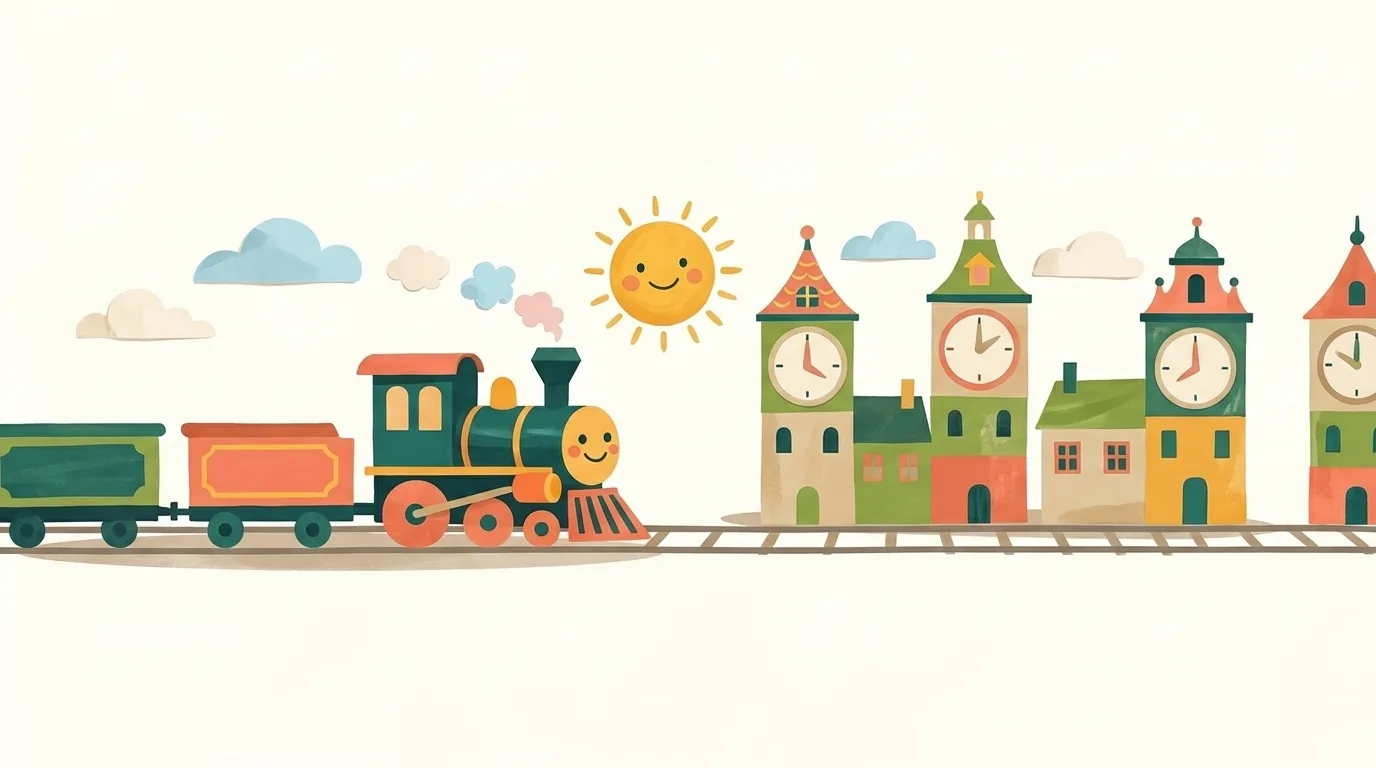
Trains made people decide! Each town once set its clocks by its own Sun, so times didn't match.
That muddled train timetables. So railways picked one shared time, and later the world agreed on zones.
It's like a class agreeing to use one clock.
Tell me more
Noon used to be whenever the Sun was highest, so the city of Bristol kept its clocks 10 minutes behind London's. In 1847, British railways switched to Greenwich time, called Railway Time. In 1884, Greenwich, in London, was chosen as the starting line for the world, called the Prime Meridian. A perfect zone would be a slice of Earth 15 degrees wide, one hour apart from the next. But zones mostly follow the borders between countries instead, so neighbors can share one time. Some huge countries, like China and India, use just one time zone.
Words to know
- Prime Meridianthe line where counting time zones starts
Try it at home
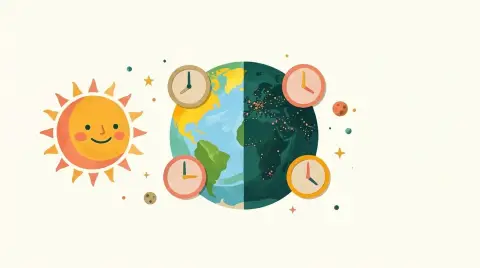
In a dark room, shine a flashlight on a ball and turn it slowly. The lit side is day and the dark side is night. Every spot gets noon at a different moment!
 Dig deeper
 What else?
 Surprise me!